Claude Duet: Anthropic's agent works on its own, but asks permission before acting
On October 21, Anthropic launched Claude Duet, an agent that works without being asked and checks in before sending or paying. What it means for small studios.
Until now, almost every text AI waited to be called. You opened the window, typed the request and got the answer. On October 21, 2026, Anthropic launched a product that flips that order.
Claude Duet is an agent that works without being asked. It watches your connected apps, flags what needs attention and gets tasks moving while you do something else. But before any action that goes out into the world, it stops and asks permission.
That combination, initiative with a brake, is what makes the launch interesting for people who work in branding and production.
What Duet does
According to the official announcement, Duet is a separate app from Claude, in research preview, built for professionals and small business owners. It runs on Claude Opus 5.5, a model the company presents as the leader in coding and agentic work.
In practice, Duet:
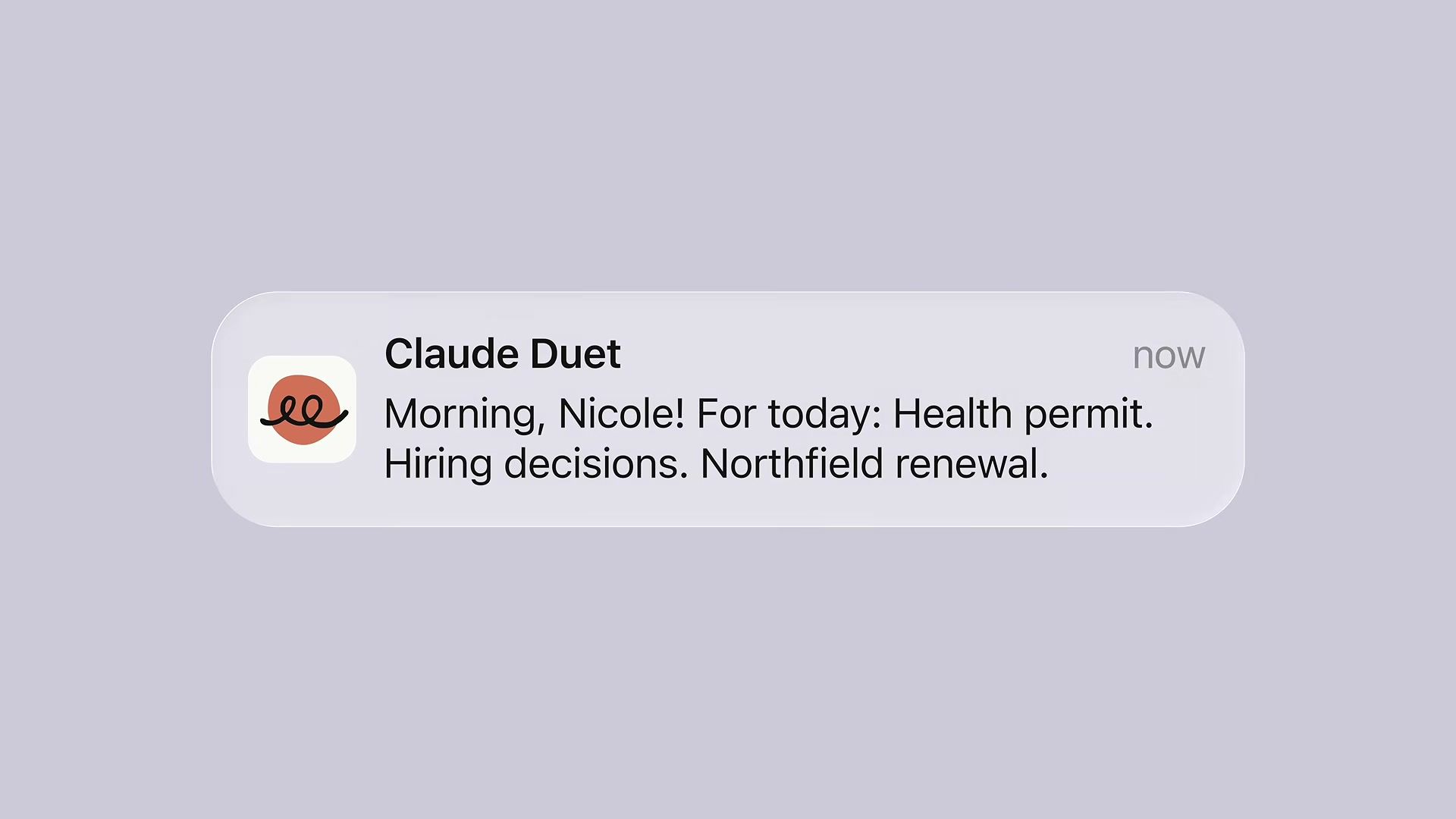
- Sends a morning brief with what matters in each connected app.
- Keeps an eye on the day and only reaches out when something needs a decision.
- Gets tasks done: scheduling meetings, building dashboards with data from several tools, sales forecasts, prototypes and even small apps.
- Keeps working with your phone off, because it runs on its own virtual machine, with its own browser.
- Talks in a single thread, by text or voice, from quick replies to multi-week projects.
Anthropic says it connects to more than 6,000 connectors and plugins in the Claude Marketplace. Examples include Gmail, Slack, HubSpot, QuickBooks, Docusign, Canva and Shopify.
The brake: you keep the final say
The launch video sums up the idea in one line: “You keep the final say.” The product was designed around it.
Before sending a message, making a payment, signing a document or deleting anything, Duet shows the exact action and waits for approval. Some actions are off-limits even with approval: it does not trade securities or move money between accounts.
There are other layers, according to the company:
- the agent never sees passwords or sign-in tokens directly;
- a classifier reviews each message to prevent sensitive data from leaking;
- requests for card numbers and government IDs are refused;
- the product was penetration-tested by an internal team and an outside firm.
Anthropic itself admits the limits. Duet can misread a conversation or misjudge what is urgent. It is weaker at personal errands, like buying tickets, than at work tasks. And it can’t yet show what it is doing in the browser.
A useful agent isn’t the one that does everything alone. It’s the one that knows when to stop and ask.
Who can use it, and when
For now, access is through a waitlist, only in the United States, for Pro and Max subscribers. Duet runs in iOS and Android apps and on claude.ai. Usage counts toward the same limits as the rest of Claude. Bigger tasks, like a financial model, use more.
There is no date for Brazil. That’s why this post has no hands-on test: everything here comes from the official announcement, the company’s video and press coverage.
Duet enters a crowded market. TechCrunch lists rivals such as Meta’s Muse and OpenAI’s Dots. CNBC highlights Anthropic’s focus on professionals and small businesses, not household chores.
What it changes for a small studio
Anyone who produces brand films knows the invisible part of the job. Before a shoot day there are dozens of small tasks: confirming the location, reminding the client to approve the script, chasing an invoice, reshuffling the schedule when rain changes the plan.
That is exactly the kind of work Duet promises to move forward. One of the examples in the announcement comes from a brand strategist: the agent prepared her brief for a client call and noticed the call fell right before a flight. So it offered to reschedule. “I love that proactivity,” she said.
For a small studio, the promise is clear: less time on support tasks, more time on directing, writing and editing.
But the promise comes with a condition, and it is built into the product itself. The agent prepares; the person decides. In production, that is not a detail:
- A message to a client is a relationship decision. The tone of a payment reminder or a deadline request changes the relationship. Agent drafts, human sends.
- Priority is a directing decision. Knowing what can wait depends on knowing the project, and Anthropic itself says Duet can get this wrong.
- Client data needs care. Before connecting email and project folders, check what your contract with the client allows.
This blog’s take
Duet confirms a trend we were already seeing in video tools: AI takes on more and more execution, and human value concentrates in the decision. It’s the same reasoning as the Grok Odyssey case: the tool speeds things up, but judgment still belongs to whoever directs.
The most interesting part of the launch isn’t what the agent does on its own. It’s the button it leaves for the person to press. In a brand film, that’s the part the client is paying for.
Sources
- Anthropic · Introducing Claude Duet (10/21/2026)
- Anthropic · Claude Duet product page
- TechCrunch · Claude Duet app is Anthropic's bet on agents (10/22/2026)
- CNBC · Anthropic announces preview of Claude Duet, a personal AI agent (10/21/2026)
- Claude (official YouTube channel) · Introducing Claude Duet (10/21/2026)